English
 русский
 Español




How Non Woven Cooler Bags Are Made for Food Delivery?
2026-10-23
A food delivery bag has to do more than hold a meal. Its outer fabric needs to handle repeated carrying, the inner lining needs to provide a layer between the contents and outside conditions, and the opening has to be practical for frequent loading. For a Non Woven Cooler Bag, these details come together during material preparation, cutting, printing, lining assembly, and bag making.
At Wenzhou Xiangqun Bags Co., Ltd., non-woven fabric production and bag manufacturing are handled within the factory's production system. The company was founded in 2005 and operates a factory covering more than 15,000 square meters, with seven non-woven fabric production lines and more than 20 sets of production equipment. Its manufacturing scope includes non-woven bags, insulated bags, garment covers, canvas bags, PVC bags, and other packaging products.
The Outer Fabric Forms the Working Structure
The production of a Non Woven Cooler Bag starts with the outer material. This product uses non-woven fabric as its exterior layer, giving the bag a lightweight structure suitable for food delivery, takeaway packaging, beverage carrying, and promotional use.
Material weight and bag dimensions need to be considered together. A larger bag carries a different load from a small promotional cooler bag, so the fabric, handle construction, bottom structure, and stitching need to match the intended order specification.
For bulk buyers, material consistency also matters during repeat production. Differences in fabric appearance, thickness, or cutting dimensions can become noticeable when hundreds or thousands of bags are packed for one customer.
The Aluminum Foil Lining Is Added During Assembly
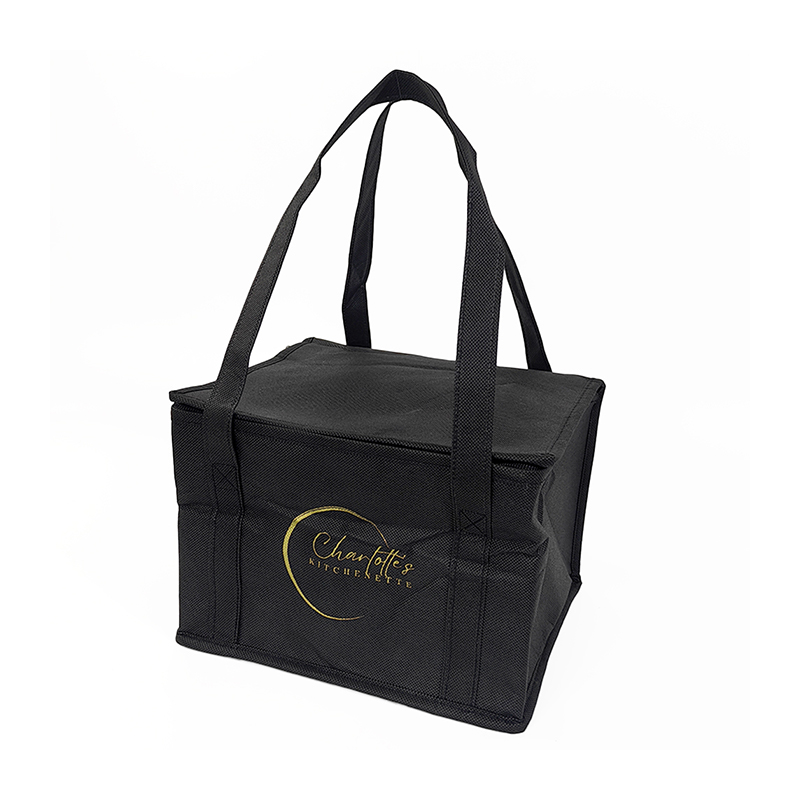
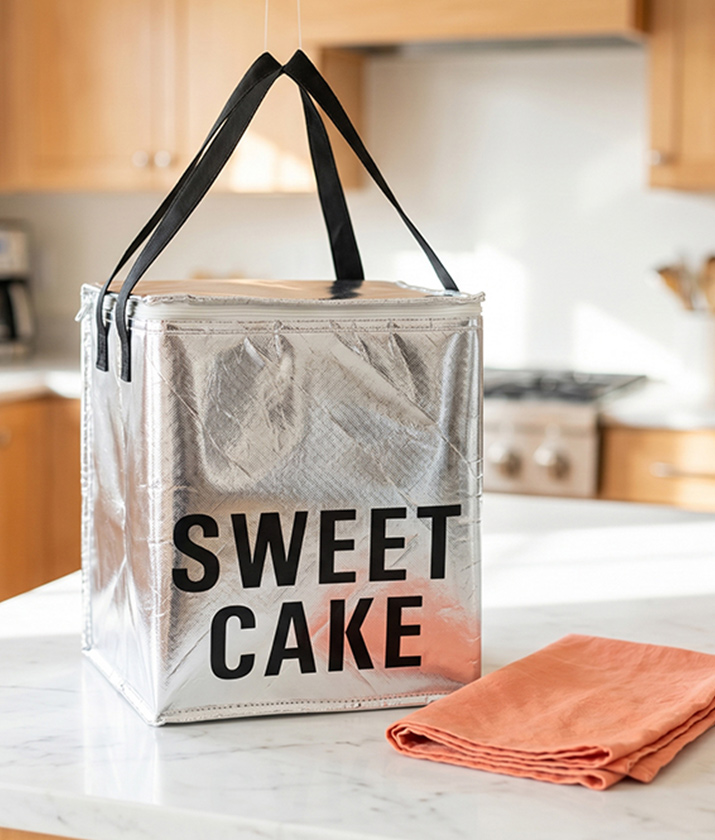
Inside the Non Woven Cooler Bag, an aluminum foil insulated lining forms the inner layer. The product page specifies a non-woven fabric outer layer combined with an aluminum foil insulated lining. The lining is intended to help food and beverages remain warm or cool during short-term carrying.
The lining also affects how the bag is assembled. Cutting dimensions need to account for the outer shell, side gussets, flat bottom, and internal lining so that the finished bag maintains its intended shape.
This structure is different from a simple non-woven shopping bag. A standard shopping bag can focus mainly on the outer fabric and handles, while an insulated version requires additional material and assembly steps inside the bag.
The Adhesive Opening Changes the Bag-Making Process
One feature that defines this Non Woven Cooler Bag is the adhesive seal strip at the top opening. Instead of using a zipper or drawstring, the opening can be folded and sealed with the adhesive strip.
For takeaway applications, this construction provides a flat top closure without adding a zipper assembly. The opening also needs to be positioned accurately so the bag can close properly after filling.
During production, the adhesive component becomes another quality-control point. Position, bonding condition, and alignment need to be checked along with the dimensions of the bag body.
Flat Bottom and Side Gussets Support Capacity
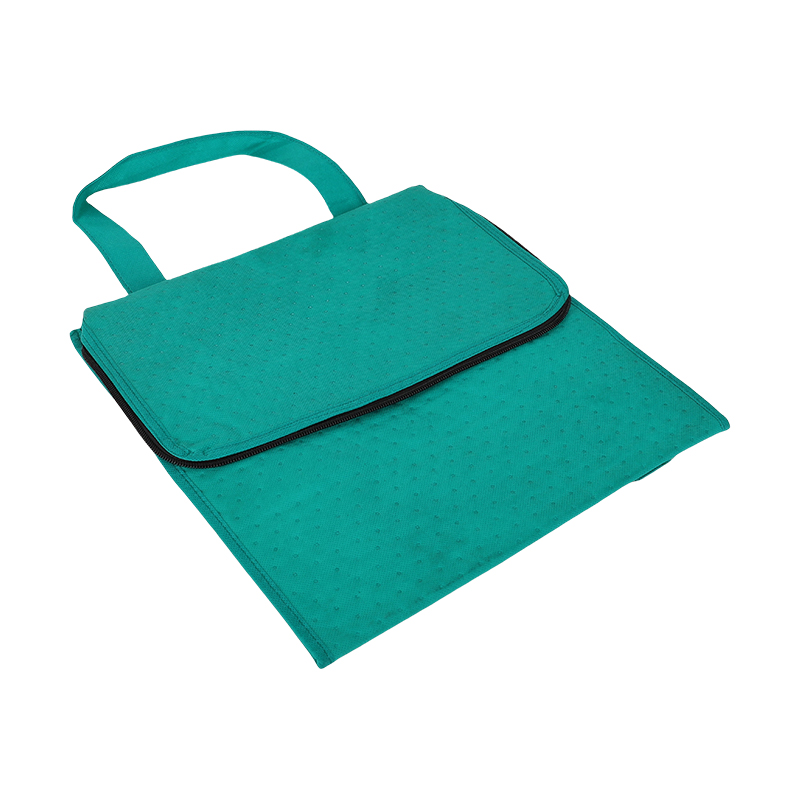
The bag uses a flat bottom and side gusset structure. These details affect how the Non Woven Cooler Bag behaves after food containers or drinks are placed inside.
A flat bottom gives the bag a defined base, while the side gussets provide additional width when the bag is filled. This construction is useful for delivery and takeaway applications where the contents are not necessarily flat or uniform in shape.
The handle is another load-bearing component. The product uses reinforced webbing handles, which are attached to the bag body during assembly. For commercial orders, handle position and reinforcement need to remain consistent across the production batch.
Printing Is Integrated With Bulk Customization
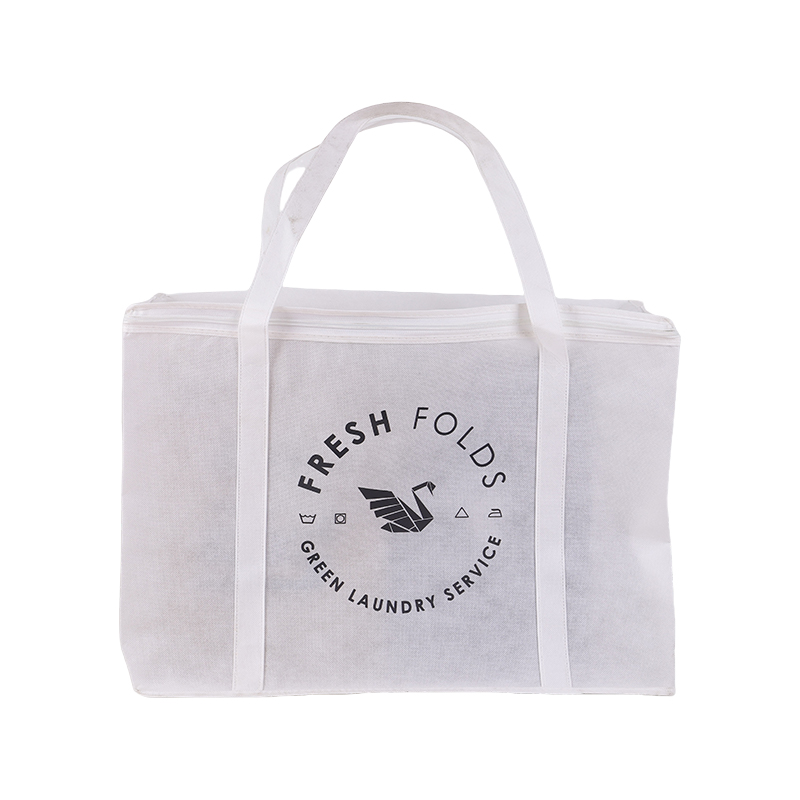
Wenzhou Xiangqun Bags Co., Ltd. supports custom logo and pattern printing for this Non Woven Cooler Bag. The product page lists full-color printing, while the factory also provides several printing processes, including heat transfer, screen printing, digital printing, and other methods for different bag materials and designs.
The appropriate printing process depends on the artwork, material, required appearance, and order specification. For food delivery companies, restaurants, supermarkets, and promotional campaigns, the printed area can turn the bag into part of the customer's packaging system.
The factory states that it undertakes both OEM and ODM projects and can customize product shape, size, material, accessories, and printing processes.
Production Control Matters More at Large Quantities
For a B2B order, the finished bag is only one part of the purchasing requirement. Buyers may need a fixed size, specific outer fabric, selected lining, printed artwork, handle construction, adhesive opening, and defined packaging method across the entire batch.
|
Production Stage |
Key Control Point |
B2B Order Impact |
|
Non-woven fabric preparation |
Material consistency |
Keeps repeated orders visually consistent |
|
Cutting |
Outer and lining dimensions |
Prevents fitting problems during assembly |
|
Printing |
Artwork position and print quality |
Maintains brand consistency across bags |
|
Lining assembly |
Alignment with outer bag |
Supports the intended insulated structure |
|
Handle attachment |
Position and reinforcement |
Affects carrying performance |
|
Adhesive closure |
Strip position and bonding |
Determines whether the opening closes correctly |
|
Final inspection |
Overall dimensions and appearance |
Reduces variation within bulk shipments |
Xiangqun states that its production process covers non-woven fabric production, design, plate-making, printing, lamination, bag-making, and finished-bag production within its workshops. This integrated setup gives the factory direct control over several stages of a custom bag order.
Custom Orders Can Start From the Bag Structure
A Non Woven Cooler Bag ordered for a restaurant chain does not necessarily need the same specification as one supplied for promotional distribution. Size, color, lining material, printing, accessories, and packaging can be adjusted according to the project.
The factory lists customization options covering style, shape, size, material, accessories, and printing process. It also reports an annual non-woven fabric output of 20,000 tons, supporting its wider production of non-woven packaging products.
For overseas importers and packaging distributors, the practical purchasing discussion can therefore start with the required bag structure and order quantity, then move into material, lining, closure, printing, and packaging specifications. This approach gives the manufacturer a clearer production brief and gives the buyer defined points for checking samples and bulk production.
Recommended Products